Introduction
Open heart surgery is one of the most precise and delicate procedures in modern medicine. It aims to treat heart diseases or defects that cannot be corrected through medication or catheterization.
Although the term “open heart surgery” might sound alarming, advancements in surgical techniques and medical technology have made it much safer, with higher success rates and fewer complications.
In this article, we’ll explain in detail what open heart surgery is, the main reasons for performing it, how it’s done, its success rate, and the most important tips for recovery after surgery.
What Is Open Heart Surgery?
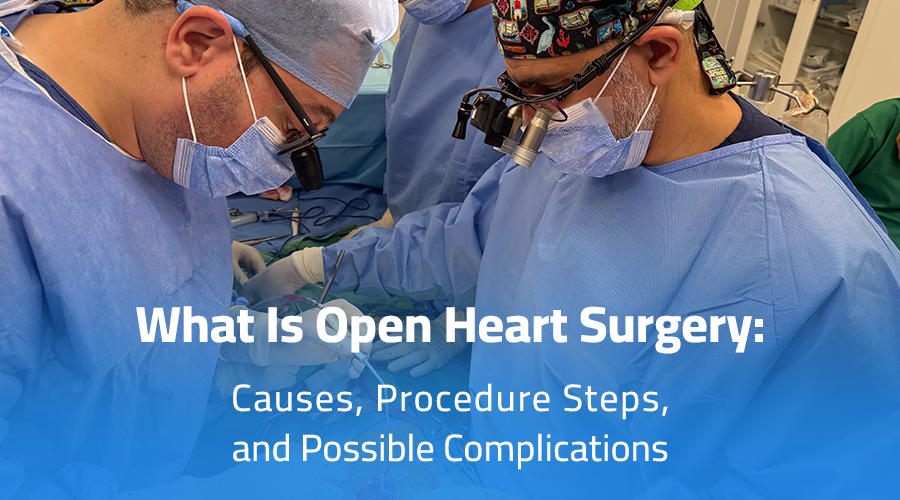
Open heart surgery is a surgical procedure in which the chest bone (sternum) is opened to access the heart muscle, in order to repair a defect or treat a problem in the arteries or valves.
During the procedure, a heart-lung machine (cardiopulmonary bypass) is used to temporarily pump and oxygenate the blood while the heart is stopped, allowing the surgeon to operate safely.
Main goals of open heart surgery include:
- Treating coronary artery blockages.
- Repairing or replacing heart valves.
- Treating aortic aneurysms.
- Correcting congenital heart defects (especially in children).
- Heart transplantation in advanced cases.
When Does a Patient Need Open Heart Surgery?
Doctors resort to open heart surgery when other methods — such as medication or catheterization — fail to improve the heart’s condition.
The most common cases requiring open heart surgery include:
- Coronary artery blockage:
Narrowing or blockage of the coronary arteries reduces blood flow to the heart muscle, leading to angina or heart attacks. - Heart valve problems:
Such as stenosis or regurgitation of the valves, which disrupts normal blood flow inside the heart. - Weak heart muscle or aortic aneurysm:
Some cases require strengthening or replacing parts of the aortic wall. - Congenital heart defects:
Especially in children, such as septal defects between the heart chambers.
Medical advice:
The decision to perform open heart surgery should only be made after a thorough evaluation by a specialized cardiac surgery team.
How Is Open Heart Surgery Performed? (Procedure Steps)
The following steps describe a simplified overview of a typical open heart surgery procedure:
- General anesthesia:
The patient is fully anesthetized to ensure a pain-free experience. - Opening the chest bone (sternotomy):
The surgeon opens the chest to access the heart. - Connecting to the heart-lung machine:
The patient is connected to the machine, which temporarily performs the functions of the heart and lungs. - Repairing the main issue:
Depending on the diagnosis — whether bypassing blocked arteries, repairing valves, or grafting vessels. - Restarting the heart:
Once the repair is completed, blood circulation is restored, and the heart begins beating again. - Closing the chest:
The breastbone is closed with surgical wires, and the incision is sutured.
Duration:
Typically lasts between 3 to 6 hours, depending on the case complexity.
Success Rate of Open Heart Surgery
Thanks to major advancements in anesthesia, surgical techniques, and intensive care, the success rate of open heart surgery now exceeds 98% in most stable cases.
However, it may vary based on:
- The patient’s age.
- The type of heart condition.
- The patient’s medical history (e.g., diabetes or hypertension).
- The experience of the surgical team.
Quick facts:
- Coronary artery bypass patients achieve a success rate above 97%.
- Valve surgeries have a success rate between 90–95%.
Possible Complications After Open Heart Surgery
Although generally safe, certain complications may occur in limited cases, such as:
- Infection at the incision site.
- Temporary irregular heartbeats (arrhythmias).
- Rare blood clots.
- Breathing difficulties post-surgery.
- Fluid retention in the lungs or legs.
- Temporary memory or concentration issues (especially in older patients).
Most of these complications are manageable under medical supervision before the patient is discharged.
Recovery After Open Heart Surgery
The recovery period plays a vital role in ensuring long-term success.
- Hospital stay: usually 5–10 days.
- Return to normal activities: typically within 6–8 weeks.
- Regular follow-up: to monitor blood pressure, cholesterol, and heart function.
Top recovery tips:
- Take prescribed medications consistently.
- Avoid lifting heavy objects or driving in the first few weeks.
- Eat a heart-healthy diet low in fat and salt.
- Engage in light physical activity after consulting your doctor.
- Attend cardiac rehabilitation sessions if recommended.
Conclusion
Despite its complexity, open heart surgery is one of the most successful and precise procedures in modern medicine.
With continuous medical progress, the surgery has become remarkably safe, helping patients regain a normal and healthy life.
If you have a heart condition and have been recommended for surgery, consult a qualified cardiac surgeon to evaluate your case and determine the best treatment plan.
Need to Evaluate Your Case or Know If You’re a Candidate for Open Heart Surgery?
Book your consultation now with Dr. Ehab Sharkawy, Assistant Professor of Cardiothoracic Surgery – Faculty of Medicine, Cairo University (Kasr Al-Ainy),
to learn about the latest techniques and safest treatment options for your condition with confidence and peace of mind.