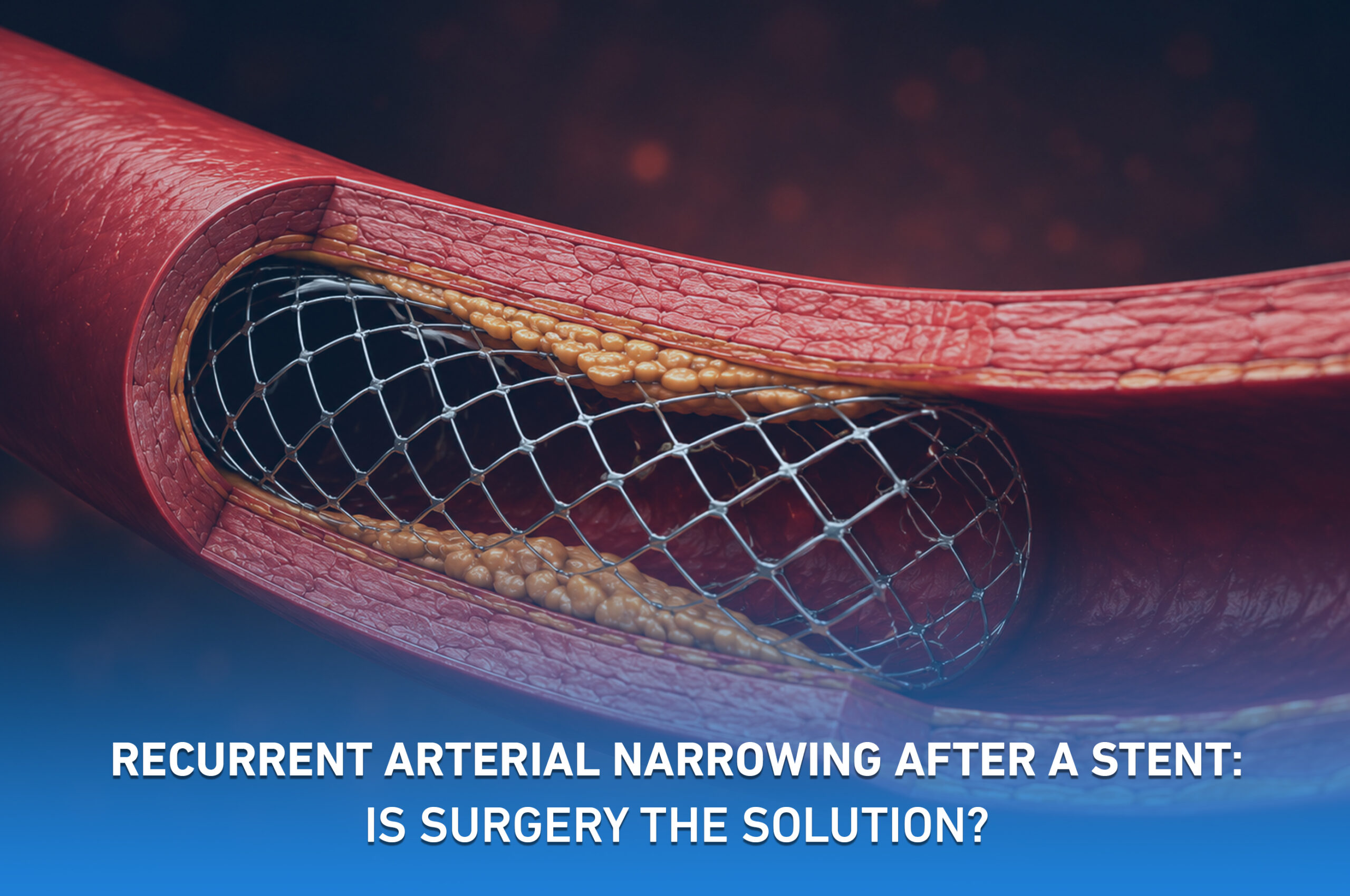
Coronary stents are one of the most effective interventional treatments for coronary artery disease. They help restore blood flow by opening narrowed arteries and relieving symptoms such as chest pain and shortness of breath.
However, in some cases, patients may experience recurrent narrowing inside or around a previously placed stent after some time. This raises an important question:
Is cardiac surgery the definitive solution in such cases?
The answer depends on multiple clinical and anatomical factors.
Why Does Re-Narrowing Occur After a Stent?
Recurrent narrowing, also known as in-stent restenosis, may occur due to:
- Excessive tissue growth inside the stent
- Inflammatory response of the arterial wall
- Poorly controlled risk factors such as diabetes
- Smoking or high cholesterol levels
- Placement of stents in long or complex lesions
Not all patients have the same risk, and recurrence is more likely in certain high-risk cases.
How Is the Condition Evaluated?
Before deciding on further treatment, a detailed assessment is required, including:
1. Coronary Angiography
This helps determine:
- Exact location of the new narrowing
- Whether it is inside the stent or in another artery
- The number of vessels involved
2. Heart Function Assessment
Usually performed using echocardiography to evaluate:
- Left ventricular function (Ejection Fraction)
- Presence of heart muscle weakness
- Overall impact of reduced blood flow
3. Symptom Evaluation
Symptoms play a major role in decision-making, such as:
- Recurrent chest pain
- Shortness of breath
- Reduced exercise capacity
The severity and frequency of symptoms help guide treatment strategy.
Can Another Stent Be Used?
In selected cases, repeat percutaneous treatment may be considered, such as:
- Balloon dilation of the narrowed segment
- Placement of a second drug-eluting stent (DES-in-DES)
- Use of specialized drug-coated balloons
However, these options are not always suitable, especially in recurrent or complex disease.
When Is Surgery the Best Option?
Coronary artery bypass grafting (CABG) may be recommended in the following situations:
1. Recurrent restenosis despite previous interventions
When narrowing keeps returning after multiple procedures.
2. Multivessel coronary artery disease
Especially when more than one major artery is affected.
3. Diabetes with diffuse coronary disease
Studies show better long-term outcomes with surgery in diabetic patients with complex disease.
4. Reduced heart function
When blood flow limitation has already weakened the heart muscle.
5. Unfavorable anatomy for stenting
Such as:
- Long or diffuse lesions
- Small or heavily calcified arteries
- Complex bifurcation disease
Advantages of Surgery Compared to Repeated Stenting
In selected patients, CABG may offer more durable results because it:
- Bypasses the blocked segment entirely
- Reduces the risk of recurrence
- Provides long-term blood flow stability
- Shows better outcomes in diabetic and multivessel disease patients
Is Surgery Always Better Than Stents?
No.
The optimal treatment depends on:
- Number of affected arteries
- Patient age and general condition
- Presence of other diseases
- Anatomy of the coronary lesions
- Previous intervention results
In some cases, repeat stenting is appropriate, while in others, surgery provides better long-term outcomes.
How Is the Final Decision Made?
The treatment strategy is usually determined by a multidisciplinary Heart Team, which includes:
- Cardiac surgeon
- Interventional cardiologist
- Clinical cardiologist
They evaluate:
- Angiography results
- Symptoms and clinical status
- Heart function
- Risk–benefit balance of each option
Conclusion
Recurrent narrowing after stent placement does not automatically mean that surgery is required. However, it is a critical signal that requires careful evaluation.
While repeat catheter-based interventions may be suitable in selected cases, coronary bypass surgery may provide a more stable and long-term solution in complex or recurrent disease.
Schedule a Consultation
If you are experiencing recurrent coronary artery narrowing after stent placement, Dr. Ihab Elsharkawy provides specialized cardiac evaluation to determine whether repeat stenting or bypass surgery is the most appropriate and safest option for your condition.