Introduction
Heart surgeries are among the most delicate and complex procedures in modern medicine, as they deal directly with the organ responsible for sustaining life.
While some heart operations are now performed routinely and relatively safely, others are considered among the most dangerous and technically demanding.
The level of risk varies from one patient to another depending on multiple factors.
In this article, we explain which types of heart surgeries are considered the most dangerous, why the level of risk differs between patients, and who may require such operations — along with a simplified overview of the main causes, steps, and possible complications.
- What Are the Most Dangerous Heart Surgeries?
The level of danger depends on the type of surgery and the patient’s health condition, but generally, four types of operations are considered the most critical and sensitive:
- Open Heart Surgery
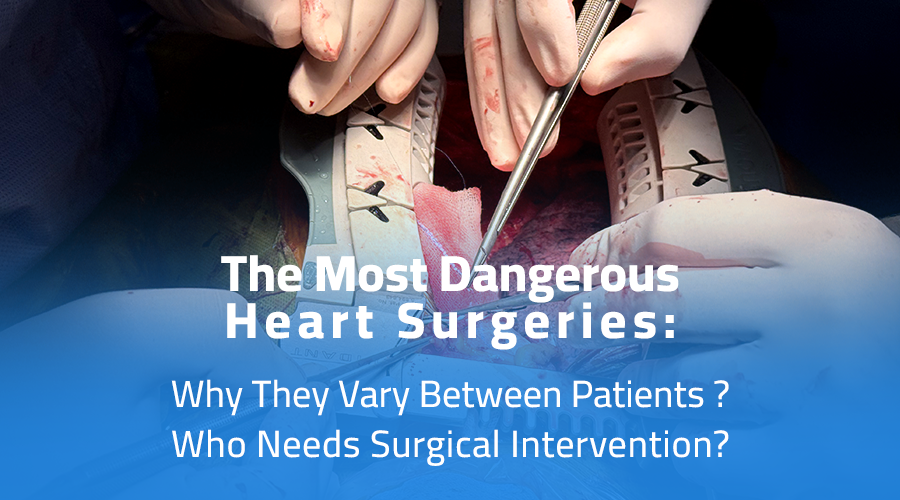
Perhaps the most well-known type, open heart surgery involves opening the chest bone (sternum) to reach the heart.
It is typically performed to bypass blocked arteries, repair or replace valves, or correct congenital defects.
Despite significant advances in technology, it remains a high-risk procedure because it involves:
- Temporarily stopping the heart and using a heart-lung bypass machine.
- Risk of bleeding or postoperative infection.
- Longer recovery time compared to less invasive methods.
- Aortic Surgery
This is considered one of the most dangerous heart operations, given the precision required to operate on the aorta — the body’s largest artery, responsible for delivering oxygenated blood from the heart to the body.
It is usually performed in cases of:
- Aortic aneurysm (aortic dilation).
- Aortic dissection or rupture.
Any delay in performing this type of surgery can be life-threatening within hours, making it a true surgical emergency.
- Heart Transplant Surgery
This is the most complex procedure medically and ethically. It involves replacing a failing heart with a healthy donor heart.
It is performed only in cases of end-stage heart failure, when all other treatment options have failed.
The surgery requires:
- A tissue match between donor and recipient.
- Intensive postoperative care to prevent organ rejection.
- Complex Heart Valve Surgery (Replacement or Repair)
Although modern techniques like catheter-based interventions and minimally invasive valve repair have improved safety, traditional surgical valve replacements — especially of the mitral or aortic valves — are still considered among the most high-risk procedures, particularly in elderly or chronically ill patients.
- Why Does the Risk Level Differ Between Patients?
Not every heart operation is equally dangerous for every patient.
The degree of risk depends on individual medical factors, including:
- Age:
Older patients are more likely to experience complications and slower recovery. - Overall health condition:
Chronic diseases like diabetes, kidney failure, or hypertension increase surgical risks. - Heart muscle condition:
Weak heart muscles reduce the heart’s ability to tolerate surgery. - Type and duration of surgery:
Operations requiring longer use of the heart-lung bypass machine are more delicate. - Experience of the surgical team:
Specialized cardiac centers with skilled surgeons achieve higher success rates and fewer complications.
Important note:
The same heart operation may be moderate-risk for one patient and high-risk for another, depending on their overall health and medical history.
- Who Needs Heart Surgery?
Surgery is usually considered when non-surgical methods such as medications or catheter procedures fail to improve blood flow or repair the heart problem.
The main groups that typically require heart surgery include:
- Patients with coronary artery blockages:
When coronary arteries are severely blocked and cannot be treated with angioplasty, bypass surgery (CABG) is performed to restore blood flow. - Patients with damaged heart valves:
Valve narrowing (stenosis) or leakage (regurgitation) can interfere with blood circulation. In such cases, valve repair or replacement may be required. - Patients with aortic aneurysm:
This condition is critical because an aortic rupture can cause fatal internal bleeding within minutes. - Patients with congenital heart defects (especially children):
Such as holes between heart chambers or malformed arteries, often corrected surgically at an early age. - Patients with severe heart failure:
Those who do not respond to medications or catheterization may require heart transplantation or a mechanical assist device.
- How Is Heart Surgery Performed? (General Steps)
Although the details vary depending on the case, most heart surgeries follow these general steps:
- Full anesthesia to ensure the patient feels no pain.
- Opening the chest bone (sternotomy) to access the heart (for open procedures).
- Connecting the heart-lung machine to maintain blood flow during surgery.
- Correcting the main issue (such as valve replacement or artery bypass).
- Restarting the heart after completing the repair.
- Closing the chest with surgical wires that remain safely inside the body.
Duration: usually between 3 to 6 hours, depending on the complexity of the case.
- Possible Complications After Heart Surgery
As with any major operation, certain postoperative complications may occur, such as:
- Mild bleeding or infection at the incision site.
- Temporary irregular heartbeat (arrhythmia).
- Fluid retention or leg swelling.
- Breathing difficulties in the first few days.
- Temporary memory or concentration problems (especially in elderly patients).
Most of these issues are manageable in the hospital under medical supervision, and patients are usually discharged in stable condition.
- Recovery After Heart Surgery
- Hospital stay: 5–10 days on average.
- Return to normal activity: usually within 6–8 weeks.
Essential tips:
- Quit smoking completely.
- Take medications as prescribed and attend regular follow-ups.
- Follow a low-fat, low-salt heart-healthy diet.
- Engage in light physical activity under medical supervision.
- Success Rate and Long-Term Outlook
The success rate of heart surgeries in specialized centers exceeds 95%, especially when patients adhere to medication and lifestyle recommendations.
Most patients return to a normal and active life within a few months after surgery.
Conclusion
The most dangerous heart surgeries are typically those involving the aorta, heart transplants, or complex valve replacements.
However, the level of risk varies widely depending on the patient’s age, overall health, and specific heart condition.
The decision to perform heart surgery should only be made after a comprehensive evaluation by a cardiologist and cardiac surgeon to ensure the safest and most suitable treatment plan.
Need Expert Evaluation or a Second Opinion?
If you have a heart condition or have been recommended for surgery, don’t hesitate to consult Dr. Ehab Sharkawy, Assistant Professor of Cardiothoracic Surgery, Faculty of Medicine – Cairo University (Kasr Al-Ainy).
Book your consultation now to learn about the latest surgical techniques and the safest treatment options tailored to your condition — with confidence and peace of mind.